Rebecca Wilks

Rebecca Wilks; Photographer, Teacher, Yarnellian, Do-Gooder

Tuesday, August 18, 2015

Stealth Photobomber


Over the years I’ve had a number of great photographic opportunities present themselves through my husband Marco.  My first feature article was for Popular Woodworking Magazine, for example, and I’ve taught myself a whole lot about photographing shiny furniture.  Woodworking is his hobby.

Marco on camera
Professionally he does some impressive technical stuff that has mostly to do with surveying. The latest project is about creating topographic maps from aerial photographs, usually made from an unmanned helicopter or fixed wing “drone.”  It’s been given the unwieldy name “photogrammetry.”

Decisive moment; the launch of the photobomber
Yesterday he, together with a professional video company , made an introductory film about the process.  I was thrilled to come along.  We met at the Caterpillar Proving Grounds in Eloy, Arizona.  I made a number of behind the scenes images of the video production process, including the catapult-launch of an impressive fixed-wing aircraft I called the stealth photobomber.  Somehow no one laughed as loud as I did at my little joke.  

I do hope that these images are helpful in promoting the project, whether in the video or elsewhere, but most of my enthusiasm lies with a side project.  I had an hour or so to wander around the huge facility with my camera and appreciate the industrial beauty of these utilitarian machines.  

Excavator as art
I need to step out of my routine sometimes in order to look at things another way, and this was a rare opportunity.  

For now, I hope you enjoy the diversion.  Before long we’ll return to our regularly scheduled images of natural beauty.

Saturday, August 15, 2015

Beauty #1

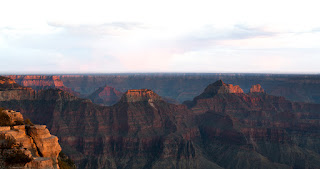
Pastel Sunrise, Crazy Jug Point, North Rim Grand Canyon


Beth turned right down the soggy forest road, headed home after we’d been traveling together for a couple of days.  I turned left, toward one of my favorite remote places to enjoy the Grand Canyon.  Before too long the downpour started.  There was 1 ½ inches in the four hours I hung out there (I happened to have left my bucket out) but it was intermittent as our summer rain generally is here.  

Astonishing Fog, Saddle Mountain Trailhead, Grand Canyon
Each time the rain stopped, I bushwhacked through the wet undergrowth to stand on a rock perched on the edge of the canyon.  Roiling fog collects in these situations, churning up from the canyon floor and defining the edges of the rock spires and outcrops.  Photographers love that.  The thing is that the cloud then accelerates and reaches up tsunami-like to engulf first the scenery and then me.  I’ve rarely experienced anything as astonishing.  Then the rain comes, sending me and my gear to hold up in the camper peering at the radar until the cycle begins again.

Fog overtaking the topography, North Rim Grand Canyon
This trip had a numinous veil from the start.  Earlier, Beth and I were bouncing down forest roads, she in her much more capable Jeep Wrangler, and listening to NPR on satellite radio.  An interview came up with John O’Donohue, a philosopher, poet, and former Catholic Priest. My sister had long ago introduced me to his work.  I radioed to Beth that she might enjoy the interview.  There were two surreal aspects to hearing this broadcast at this time; Father John had died in 2008, and he was talking about beauty and landscape.  I find his words truly profound and these were just what I needed in that moment, when I was wondering why I feel eternally drawn back to this and other special landscapes.  Beauty, he says, is not a luxury.

       “Beauty is the illumination of your soul.”
             
--John O'Donohue


Later, over a burger at the Kaibab Lodge, I shared a delightful conversation with a friend who lives at the North Rim and possesses an remarkably generous heart.  The conversation was all over the place, but we touched on providence and fate a bit. Why do we share our journey with particular souls?  I reflected on Father John's writings about the genuine beauty and creativity in friendship.

In truth, a trip like this makes the photography seem secondary.  Don’t worry; I shot plenty, and my favorite images from the trip are in the Summer 2015 gallery on the website.

Here's a poem from Father John.  I hope it inspires you as much as it does me.

        “You have traveled too fast over false ground;
           Now your soul has come to take you back.

           Take refuge in your senses, open up
           To all the small miracles you rushed through.
           Become inclined to watch the way of rain
           When it falls slow and free.

           Imitate the habit of twilight,
           Taking time to open the well of color
           That fostered the brightness of day.

           Draw alongside the silence of stone
           Until its calmness can claim you.”


On the way home; Lurch in the sunflower bloom near Flagstaff
     

Tuesday, July 21, 2015

“Do I have to?” Chapter Two; Filters


Well, sometimes you don’t have to.  Modern photographic processing software will do a lot of what used to require physical filters.  There are a few types of filters that should be in the landscape photographer’s bag, though.

First, the circular polarizer (CP) filters. The CP does things for you that Photoshop just can’t do. 
Typically we think of polarizing filters as tools to make a blue sky darker.  This it will do, though what’s really happening is an increase in contrast.  This effect of the polarizing filter is greatest when the sun is at ninety degrees to the axis of the camera, that is off one of your shoulders. 
 
Funky polarization effect, Grand Canyon
When the sun is behind or directly in front of you, you won’t see much effect.  With wider-angle lenses (you can start seeing this at 30-40mm) there’s an uneven effect across the sky which can look quite unnatural.  Sometimes that’s hard to see on your LCD screen.  When in doubt, shoot the same image with varying degrees of polarization.  
 
Reflection optimized with CP filter
The CP can do much more for you, though.  For example it can minimize or maximize reflections in water and it can reduce unattractive shine on foliage.

It is wisest to remove the CP when you don’t have a specific purpose in mind for it, as it can reduce light transmission through the lens by a full stop or more.

The second group of filters you won’t want to be without are neutral density (ND), a subset of which is graduated neutral density filters (GND), also known as split neutral density filters.  I’ll get back to that.

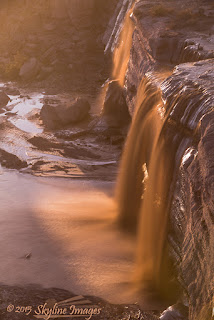
Grand Falls, Little Colorado River without ND Filter (1/20 second shutter speed)
Grand Falls, Little Colorado River with ND Filter (10 second shutter speed)
The concept of ND filters is simple; they’re dark.  “Neutral” in this case means that they don’t alter color. Sometimes the goal is to use a slower shutter speed than is possible without a filter.  Commonly we want to do this to “slow down” or smooth out moving water.  The effect is easy enough to do at dawn and dusk, when the light is low.  To create the effect under brighter conditions, though, we need the help of NDs. 

Longer exposures of moving clouds can be lovely, too.  These filters are available to screw in or as flat plates which are used with a holder.

GND filters are almost always used as flat plates in holders.  They’re useful for scenes which have a fairly abrupt transition from light to dark areas, like a bright sky and much darker land.  
 
Grand Canyon, with GND Filter

Grand Canyon, without GND Filter

While many argue that bracketing exposures and combining them using HDR (“high dynamic range”) software can take the place of GNDs, there are still times when it is desirable to shoot the image properly in one exposure.  You will find that this is a controversial point.   

GNDs are made with soft or hard transitions, the choice depending upon the requirements of the scene.  The reason that screw-in GNDs are not commonly used (though you’ll see them for sale) is that the transition, and therefore the horizon, will fall in the center of your composition.  Occasionally composing a scene so that your horizon is centered may be desirable, but the vast majority of good compositions will feature horizons above or below center.  The flat filter in a holder can be adjusted up and down as desired.  In short, don’t use screw-in GNDs.

Sometimes GNDs create artifact that must be corrected (or in some cases cannot be).  For example, if your scene includes trees which extend in front of the sky, darkening them along with the sky can look unnatural.

One last thought; buy good ones.  There’s little point in putting an optically poor filter in front of your sharp, state-of-the art lens.  With good care, they should last a lifetime.
 
Mindshift Filter Hive
You might want to check out some of the innovative and space-saving filter holders from Mindshift Gear.  I love my filter hive.

As always, thanks for the visit.  I hope to see you out there.